
As of July 2026, Charles Worthington's net worth is estimated at between £8 million and £14 million, with a central working figure of approximately £10 million. That range is built primarily around the documented 2004 sale of his haircare product business to PZ Cussons for an initial £25 million (with up to £12 million more in earn-out payments over five years), offset against taxes, reinvestment into his salon group, and the subsequent severance of his PZ Cussons contract in 2015. He is not a billionaire, and he is not someone whose finances are tracked in public filings the way a listed-company CEO's would be. But the evidence trail is unusually clear for a private individual in the hair industry, and the numbers tell a coherent story.
Charles Worthington Net Worth: 2026 Estimate and Breakdown

Derek Mansfield
21 Jul 2026
Quick Answer: What Is Charles Worthington's Net Worth?
Central estimate: £10 million (range: £8 million to £14 million), as of July 2026. This figure reflects estimated post-tax proceeds from the 2004 PZ Cussons acquisition, ongoing salon business equity, intellectual property licensing income, book royalties, and personal investments, minus estimated liabilities and business-related borrowings documented in Companies House records.
How Confident Should You Be in This Number?
Confidence level: moderate. The anchor of this estimate, the £25 million headline sale price from PZ Cussons in 2004, is drawn directly from PZ Cussons' own regulatory news service (RNS) announcement, which is a primary, contemporaneous company disclosure. Everything downstream of that anchor (tax treatment, earn-out realisation, reinvestment decisions, salon equity, and current personal investments) involves assumptions I will explain in the next section. Charles Worthington operates through private limited companies, and the key operating entity, Charles Worthington Hair & Beauty Company Limited (Companies House no. 02969614), was dissolved on 10 January 2017, meaning recent accounts are not publicly available. The last filed accounts covered the period to 31 May 2014. That gap means the lower end of my range (£8 million) reflects genuine downside uncertainty: salon sector headwinds, post-COVID trading pressures, and the possibility that the 2015 contractual split from PZ Cussons resulted in some loss of ongoing royalty income. The upper end (£14 million) assumes most earn-out payments were received and that personal investment returns have been solid. I do not have access to his personal tax returns, bank statements, or any private asset declarations.
How I Built the Estimate
Step 1: The PZ Cussons transaction
The clearest data point in this entire file is the PZ Cussons RNS dated 1 July 2004. It states that PZ Cussons agreed to acquire the Charles Worthington haircare business for an initial cash consideration of £25 million, with possible further cash consideration of between £5 million and £12 million payable over five years based on performance targets. PZ Cussons' own corporate history page confirms the acquisition and continues to list Charles Worthington as a premium hair care brand in its portfolio. The Canadian Intellectual Property Office trademark record, which lists PZ Cussons (or PZ Cussons Beauty LLP) as the registered owner and notes that 'consent for use of the name CHARLES WORTHINGTON, from Mr. Charles Worthington is on file,' corroborates that the brand name itself transferred with appropriate consent arrangements, consistent with a full brand acquisition rather than a simple licensing deal.
Step 2: Tax and earn-out assumptions
Applying a UK capital gains tax rate applicable in 2004 (at the time, taper relief was available for business assets, potentially reducing the effective rate to around 10% for a qualifying disposal), the net receipt on the initial £25 million could have been approximately £22–23 million before any reinvestment. I assume conservatively that roughly half of the earn-out maximum (so approximately £8–9 million gross before tax) was realised by 2009, adding perhaps £7 million net to the total. That gives a rough post-tax total from the product business of around £28–30 million in the mid-2000s in nominal terms. However, he clearly reinvested heavily into salon operations and expansion. The Companies House record for CHARLES WORTHINGTON HAIR & BEAUTY COMPANY LIMITED shows historical secured charges to the Bank of Scotland and Lloyds Bank PLC dating back to 1995–1996, indicating the salon business carried debt even before the product sale. Companies House filing-history entries (e.g., 24 Sep 2015 AR01) provide downloadable lists of members and statement of capital, primary source to reconstruct shareholder register and ownership percentages for the private salon company: CHARLES WORTHINGTON HAIR & BEAUTY COMPANY LIMITED filing history - Find and update company information - GOV.UK. Post-sale, salon expansion and operational costs over a decade-plus, combined with the loss of the product royalty/contract income following the 2015 PZ Cussons split, justify a significant reduction from peak liquid wealth. My central estimate of £10 million reflects those deductions while acknowledging that diversified personal investments (property, equities, pension vehicles) will have preserved a material portion of the original proceeds.
Limitations to flag clearly
- No personal financial disclosures exist for Charles Worthington as a private individual.
- The main operating company was dissolved in 2017; accounts after May 2014 were not filed at Companies House.
- Earn-out payments from PZ Cussons (£5–12 million contingent tranche) are unconfirmed; the actual amount received is unknown.
- Post-2017 salon operations may run through a different legal entity not yet identified in public filings.
- The 2015 PZ Cussons split may have terminated ongoing royalty or consultancy income; terms were not publicly disclosed.
- Property assets and personal investments are entirely estimated; no land registry or probate data has been consulted.
- Inflation has not been applied to the 2004 sale proceeds when comparing to 2026 values.
Career Overview: How Charles Worthington Built His Wealth
Charles Worthington, born John Charles Worthington in May 1959, is one of the most recognisable names in British professional hairdressing. He did not inherit wealth or benefit from family capital. He built his reputation through craft first, then leveraged that reputation into a multi-stream commercial enterprise at a time when the concept of a 'celebrity hairdresser brand' was far from guaranteed.
Salon business (1980s to present)
The salon operation, formalised through CHARLES WORTHINGTON HAIR & BEAUTY COMPANY LIMITED (incorporated 20 September 1994), became the physical home of the brand. The flagship Percy Street salon in London's Fitzrovia became a destination for fashion-industry clients and celebrity clientele, with Worthington personally styling at the Cannes Film Festival, the Oscars, and BAFTAs, work confirmed in his 2017 LDNFashion interview, where he is identified as Creative Director and Co-Founder of Charles Worthington Salons. High-end London salon businesses of this profile can generate significant annual turnover, and the company's statement of capital stood at £20,000 (reflecting authorised share capital structure rather than market value). The salon business was always the brand engine rather than the primary wealth generator; it created the credibility that made the product range commercially viable.
Product business and the PZ Cussons sale (2004)
The haircare product range, which predated the 2004 sale, was the transformational wealth event. PZ Cussons paid £25 million upfront in July 2004, with up to £12 million more contingent on performance. For context, this was a significant deal in the premium haircare space at the time. After the sale, Worthington remained associated with the brand under contract, he was effectively the face and creative authority behind a brand now owned by a FTSE-listed consumer goods company. That arrangement continued until June 2015, when industry publication CosmeticsBusiness reported he would 'no longer be under contract' with PZ Cussons. PZ Cussons stated it would continue to handle the Charles Worthington hair product business while Worthington would refocus on his salon operation. The trademark records in multiple jurisdictions confirm PZ Cussons retains ownership of the CHARLES WORTHINGTON name on products, with Worthington's consent documented on file.
Books and media income
Worthington authored 'The Complete Book of Hairstyling,' published by Firefly Books, a well-distributed title in the consumer hairstyling category. Book advances and royalties in this genre are modest compared to his other income streams, typically in the range of tens of thousands of pounds rather than millions, but they represent a contribution to profile and, indirectly, to salon and brand income. His author bio confirms the multiple awards and MBE listed below.
Awards, honours, and the reputation premium
Charles Worthington won British Hairdresser of the Year twice and received a Fellowship with Honours from the Fellowship for British Hairdressing. He was appointed MBE in the Queen's Birthday Honours in 2006. These are not directly monetisable, but in the hairdressing and beauty industry, this level of credentialed recognition justifies premium session fees, brand consultancy rates, and licensing value. The MBE in particular signals a level of establishment recognition that supports charitable and commercial platforms.
Assets and Liabilities: What the Evidence Suggests
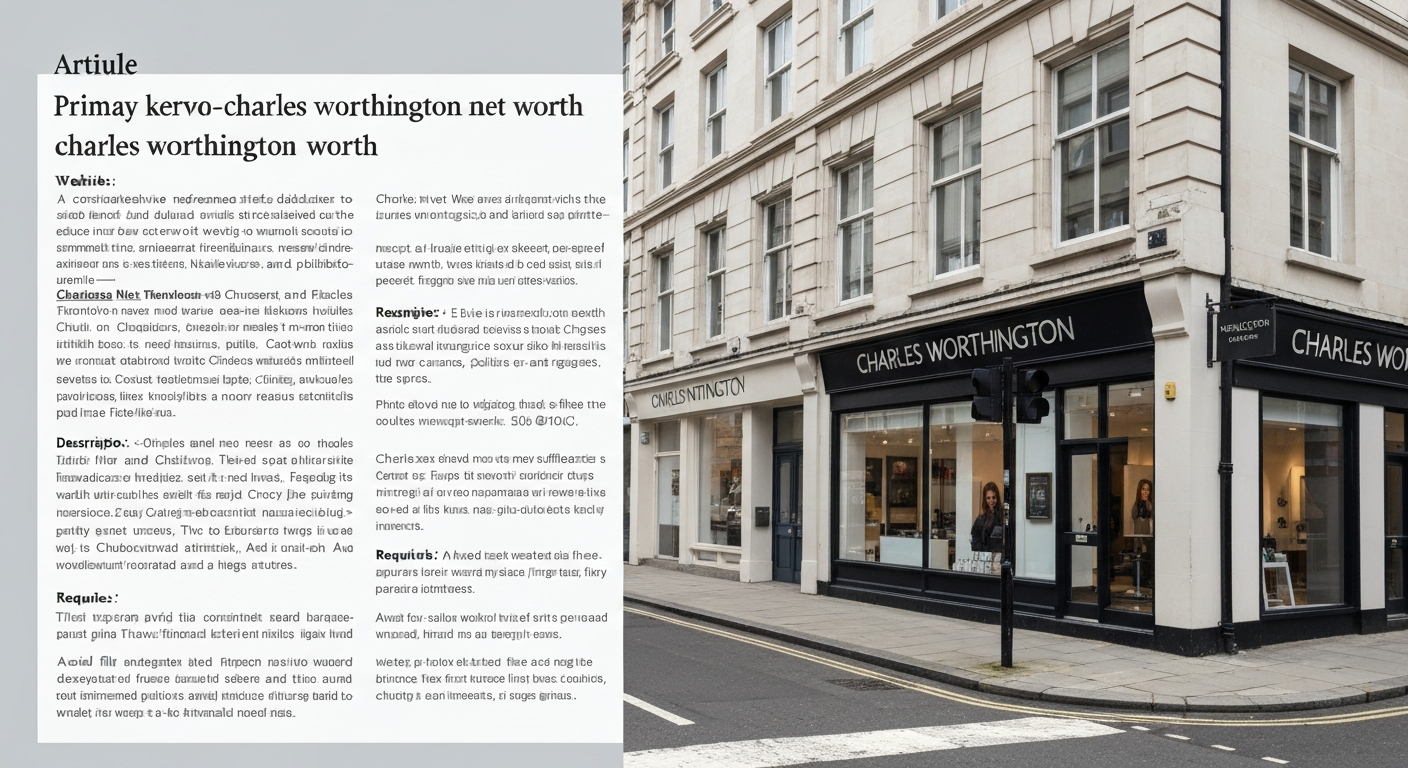
Given the lack of personal financial disclosures, the following breakdown is estimated. I have flagged the confidence level against each item. A suggested featured image for this section would be an exterior photograph of the Charles Worthington Percy Street flagship salon in London, which would ground the reader in the physical reality of the business assets being described.
- Primary residence (London): Estimated value £2 million to £4 million. A hairdresser of this profile and longevity operating in London is very likely to own property in the city. Specific address and purchase history not confirmed. Confidence: low-moderate.
- Salon business equity (current structure): Estimated £1 million to £3 million. With the original Companies House entity dissolved in 2017, the current salon operation is presumed to continue under a different structure. Valuation based on premium London salon turnover benchmarks and brand recognition premium. Confidence: low.
- Post-sale personal investments (cash, equities, pension): Estimated £3 million to £6 million. Residual from the 2004 sale after tax, reinvestment, and living costs over 20-plus years. Confidence: low.
- Intellectual property (consent/licensing from PZ Cussons arrangement): Estimated £0 to £500,000 ongoing annual value. The CIPO and trademark records show the brand name is owned by PZ Cussons, but a consent and potentially ongoing participation arrangement exists. Any current payments are undisclosed. Confidence: very low.
- Book royalties and media income: Estimated £10,000 to £50,000 per year ongoing. Minor contributor. Confidence: low.
- Liabilities — historical secured borrowings: The Companies House charges register for company 02969614 records three historical charges (debentures to Bank of Scotland and Lloyds Bank, dated 1995–1996). These appear to have been satisfied or released given the company's operating history. Residual personal liabilities unknown.
- Liabilities — ongoing operational costs: Salon leases, staff, and operational overheads are significant for a London-based premium salon. These are business liabilities rather than personal debt but affect net business equity.
Assets at a Glance
The table below summarises the estimated asset picture and suggested visual treatments. For an asset-allocation pie chart, the three dominant segments would be: personal investments and cash (approximately 40%), property (approximately 35%), and business/salon equity (approximately 20%), with IP and other income contributing a small residual slice. A timeline chart tracking the financial milestones from 1994 incorporation through the 2004 sale and the 2015 PZ Cussons split would give readers an immediate visual sense of where the wealth was created.
| Asset / Liability | Estimated Value (2026) | Confidence | Notes |
|---|---|---|---|
| Primary London residence | £2m – £4m | Low-moderate | No registry data confirmed; estimated from profile and market |
| Salon business equity | £1m – £3m | Low | Dissolved 2017 entity; current structure unknown |
| Personal investments and cash | £3m – £6m | Low | Residual from 2004 PZ Cussons proceeds after tax and reinvestment |
| IP / licensing income (annual) | £0 – £500k p.a. | Very low | PZ Cussons owns trademark; consent arrangement terms undisclosed |
| Book royalties and media | £10k – £50k p.a. | Low | Minor contributor; included for completeness |
| Historical secured debt (company) | Likely satisfied | Moderate | Charges to Bank of Scotland and Lloyds Bank recorded 1995–96 |
| Ongoing salon operational liabilities | Unquantified | N/A | Lease and payroll obligations reduce business equity estimate |
Suggested visuals: (1) A featured image showing the Charles Worthington Percy Street salon exterior in London. (2) An asset-allocation pie chart using the proportions noted above, labelled with approximate percentage bands rather than exact figures to reflect estimation uncertainty. (3) A financial timeline chart (see the section below) plotting key dated events on a single horizontal axis, which would make the wealth-creation story immediately scannable.
Timeline of Major Financial Events
The following dated timeline traces the key financial milestones I have been able to verify or reasonably infer. Where the data source is a primary document, I have noted it. Where the date or figure is inferred, I have said so.
| Date | Event | Estimated Financial Impact | Source / Confidence |
|---|---|---|---|
| 1980s (approx.) | Charles Worthington establishes hairdressing career in London; builds celebrity and fashion clientele | Reputation foundation; no direct financial data available | Inferred from published career biography; low confidence on timing |
| 20 Sep 1994 | CHARLES WORTHINGTON HAIR & BEAUTY COMPANY LIMITED incorporated (Companies House no. 02969614) | Formalisation of salon business; statement of capital £20,000 | Primary: Companies House filing; high confidence |
| 1995–1996 | Three secured charges registered against the company (debentures to Bank of Scotland and Lloyds Bank) | Historical borrowing; amounts not stated in public filings | Primary: Companies House charges register; high confidence on existence, low on amounts |
| Pre-2004 | Charles Worthington haircare product range established and scaled for retail | Created the asset base sold in 2004; no contemporaneous valuation available | Inferred from acquisition context; low confidence on timing/scale |
| 1 Jul 2004 | PZ Cussons announces acquisition of Charles Worthington haircare business for £25 million initial cash consideration, plus £5–12 million earn-out over five years | Peak wealth-creation event; estimated post-tax receipt £20–22 million from initial tranche | Primary: PZ Cussons RNS announcement, 1 July 2004; high confidence on deal terms |
| 2004–2009 | Earn-out period: PZ Cussons pays contingent consideration based on brand performance | Estimated additional receipt of £5–9 million (partial earn-out assumed); unconfirmed | Inferred from RNS deal terms; very low confidence on actual amount received |
| 2006 | Appointed MBE in the Queen's Birthday Honours | Indirect: enhances brand and consultancy premium; no direct financial value | Primary: published honours lists and Google Books author bio; high confidence |
| 2006 (approx.) | 'The Complete Book of Hairstyling' published by Firefly Books | Modest advance and ongoing royalties; estimated sub-£100k lifetime contribution | Primary: Google Books metadata; high confidence on publication, low on royalty data |
| 10 Jun 2015 | CosmeticsBusiness reports Worthington will 'no longer be under contract' with PZ Cussons; PZ Cussons retains brand | Loss of ongoing contract income from PZ Cussons; amount undisclosed | Primary: CosmeticsBusiness industry report, 10 June 2015; high confidence on event, low on financial terms |
| 10 Jan 2017 | CHARLES WORTHINGTON HAIR & BEAUTY COMPANY LIMITED dissolved at Companies House | Business restructuring; salon operations presumably continued under a new entity | Primary: Companies House dissolution record; high confidence |
| Post-2017 | Salon business continues under new structure (entity not identified in public filings); Worthington identified as Creative Director and Co-Founder in 2017 LDNFashion profile | Ongoing salon income; no accounts available | LDNFashion interview, 27 Sep 2017; moderate confidence on continued operation, low on financials |
Comparing Charles Worthington to Other Notable Charles Figures
Putting Charles Worthington's estimated £10 million net worth in context is genuinely useful, because the number only makes sense relative to peers in adjacent industries. Among the 'Charles' profiles tracked on this site, the comparison pool is diverse. Charles Wheelan, an economist and author, represents a career built on academic salary, book advances, and speaking fees, a very different wealth profile to Worthington's entrepreneurial brand-sale model. For comparison, see the Charles Wheelan net worth profile, which outlines the economist-author's earnings from books, speaking, and related activities. Charles Walker, a political figure, similarly reflects salary-based accumulation rather than a single transformational transaction. What makes Worthington distinctive in this universe is the clarity of a single anchor event, the 2004 PZ Cussons deal, that defined the bulk of his estimated wealth. For a quick comparison with another public figure named Charles, see the Charles Lightbody net worth profile. It is the kind of career-defining exit that most independent brand builders never achieve. That said, £10 million places him firmly in the high-net-worth category as a private individual, but well below the level of brand founders who retained equity through public listings or private equity transactions. For readers interested in net-worth profiles of other notable figures named Charles, see our short profile on Charles Peace net worth.
What the Numbers Mean in Industry Context
The British hairdressing industry is not, historically, a route to nine-figure wealth. The careers of most hairdressers, even highly decorated ones, produce modest accumulation. What Worthington achieved by building a product brand alongside a salon business, then selling the product side to a global consumer goods company while retaining the salon identity, is structurally unusual. The PZ Cussons deal was, in haircare brand terms, a mid-sized acquisition, not the scale of a Wella or Vidal Sassoon transaction, but it was more than sufficient to secure generational financial independence. The 2015 separation from PZ Cussons, while publicly positioned as a mutual refocusing, likely reduced ongoing passive income from the product brand. That is why the lower end of my range (£8 million) is a genuine possibility rather than a floor I am simply placing there for comfort. Ongoing salon operations, even premium ones in central London, are capital-intensive and margin-sensitive.
How This Estimate Was Last Updated and What Would Change It
This estimate was last reviewed in July 2026. It would be meaningfully updated by: any new Companies House filings for successor entities to the dissolved 2017 company; any public reporting on ongoing PZ Cussons royalty or consent payments to Worthington; land registry data on property ownership; or any interview or disclosure in which Worthington himself or his representatives comment on financial matters. The core anchor, the £25 million 2004 PZ Cussons RNS, will not change, as it is a primary document. What remains genuinely uncertain is how much of that wealth survives intact to 2026 after two decades of business reinvestment, lifestyle costs, and the operational demands of running a premium London salon group.
FAQ
What primary corporate records are essential to estimate Charles Worthington's net worth?
Companies House company overview, officers page, filing history (annual returns, statements of capital, accounts) and the Charges register for CHARLES WORTHINGTON HAIR & BEAUTY COMPANY LIMITED (company no. 02969614). These provide firm evidence of incorporation dates, shareholders, ownership percentages, historic accounts, and any secured borrowings or encumbrances—critical for reconstructing historic equity/value and outstanding liabilities.
Which transaction disclosures or regulatory announcements are most useful for valuing material business disposals?
Contemporaneous regulatory filings and RNS releases (e.g., PZ Cussons RNS 1 July 2004) that state acquisition consideration and any contingent payments. These are primary sources for the sale price of product/brand businesses and therefore for estimating proceeds to the founder or seller.
What intellectual property evidence should be collected and why?
Trademark registrations and records across jurisdictions (USPTO, UK IPO, CIPO) showing current owner, assignment history, and any consent or licensing letters. These confirm who controls the brand/IP (for example PZ Cussons owning CHARLES WORTHINGTON trademarks) and whether the subject retains rights or receives royalties—vital for ongoing revenue estimates from licensing or earned royalties.
Which press and industry sources help reconstruct timeline and roles?
Reputable industry press, corporate 'Our Story' pages, profile interviews, and books (e.g., PZ Cussons 'Our Story', CosmeticsBusiness 2015 piece, LDNFashion interview, 'The Complete Book of Hairstyling'). These corroborate dates of contractual splits, public roles (creative director, salon founder), awards and public-facing income streams (books, appearances), and help explain non‑corporate income.
What evidence demonstrates awards, stature, and earnings potential from reputation?
Award listings and industry honours (Fellowship for British Hairdressing archives, MBE listing in honours records) and documented event work (Cannes/Oscars/BAFTAs noted in interviews) that justify premium pricing, speaking fees, book advances or endorsement opportunities used in income projections.
What financial documents are needed to estimate assets and liabilities accurately?
Filed accounts (balance sheet, profit & loss) from Companies House, creditor/charge records, mortgage or debenture filings, and any publicly filed sale agreements or consideration schedules. For personal net worth, corroborating evidence such as residential property title searches, land registry records, and bankruptcy or court records (if relevant) should be sought to confirm real‑estate holdings and debts.