
There is no single "Charles Green" net worth figure, because several notable people have carried that name across very different eras and fields. The most searched is Charles Alexander Green, the British businessman who led the controversial acquisition of Rangers FC in 2012 for £5.5 million, but no credible, dated personal net worth figure for him has ever been published by a major wealth-tracking outlet. For the other Charles Greens covered here, including the Victorian balloonist, the 19th-century Savannah cotton merchant, and the US Air Force Surgeon General, we face the same honest limitation: public records support their careers and financial activities, but verifiable personal net worth totals do not exist in the public domain. What this article does is lay out what we do know, documented and dated, so you can draw your own informed picture.
Charles Green Net Worth: Estimates, Assets & Profile

Net worth at a glance (as of August 2026)
| Name | Field / Era | Estimated Net Worth | Confidence Level | Last Reviewed |
|---|---|---|---|---|
| Charles Alexander Green (b. 1953) | Business / Football | Not publicly established | Low — no filed or published figure | August 2026 |
| Charles Green (1785–1870) | Ballooning / Victorian era | Historical — not quantifiable in modern terms | Informational only | August 2026 |
| Charles Green (1734–1771) | Astronomy / 18th century | Historical — not quantifiable in modern terms | Informational only | August 2026 |
| Charles Green (cotton merchant, d. circa 1880s) | Trade / 19th-century Savannah | Wealthy by era — $93,000 house cost (1853) | Partial / historical | August 2026 |
| Lt. Gen. Charles B. Green (ret. 2012) | US Military / Medicine | Not publicly disclosed | Low — no public filing | August 2026 |
| Charles John Green (1888–1974) | Polar exploration / cook | No wealth record | Informational only | August 2026 |
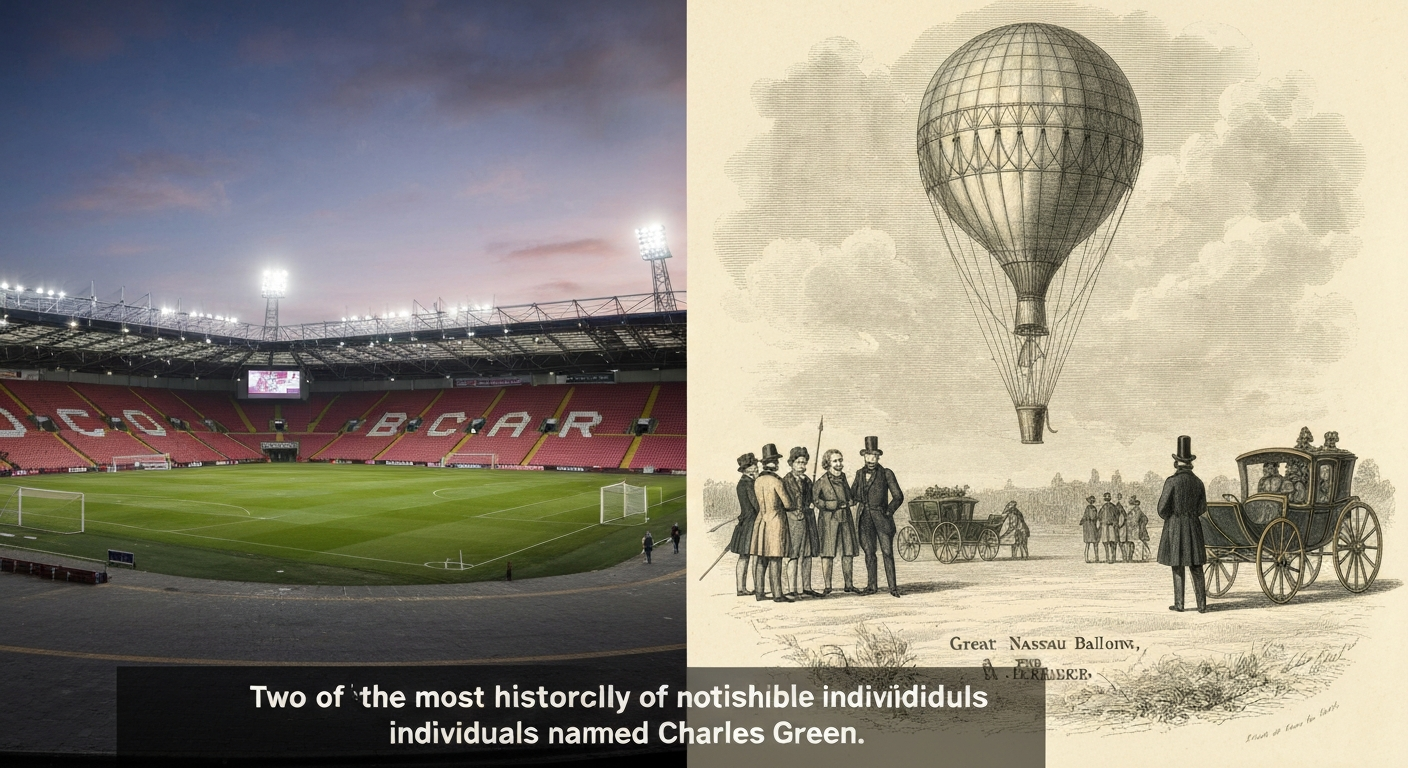
Image suggestion: a split composite image showing the Ibrox Stadium exterior (representing Charles Alexander Green's Rangers chapter) alongside a period illustration of a 19th-century gas balloon ascent (representing Charles Green the balloonist), with a neutral caption reading 'Two of the most historically notable individuals named Charles Green, separated by more than a century.'
Which Charles Green are you looking for?
Before going deeper, it is worth being clear about who is who, because searches for this name pull up at least five genuinely distinct historical and contemporary figures. If you were searching for information on Charles Gay's net worth, see the separate Charles Gay net worth profile for dedicated coverage. None of them are the same person, and mixing up their financial narratives would be misleading.
- Charles Alexander Green (born 1953, Mexborough, South Yorkshire) — British businessman, venture capitalist, former CEO of Rangers FC (2012–2013) and previously involved with Sheffield United FC. The most searched name in this group today.
- Charles Green (1785–1870) — England's most celebrated Victorian balloonist, who made hundreds of ascents and completed a record 480-mile flight from Vauxhall to Weilburg, Germany, in 1836.
- Charles Green (baptised 26 December 1734 – died 29 January 1771) — 18th-century British astronomer who sailed with Captain James Cook aboard HMS Endeavour to observe the 1769 Transit of Venus.
- Charles Green (mid-19th century, Savannah, Georgia) — prosperous cotton merchant who commissioned the Green-Meldrim House in 1853 at a reported cost of $93,000, one of the finest Gothic Revival homes in the American South.
- Lt. Gen. Charles B. Green (retired July 19, 2012) — Surgeon General of the United States Air Force, who served 34 years in military medicine before retiring.
- Charles John Green (24 November 1888 – 26 September 1974) — ship's cook aboard Ernest Shackleton's Endurance during the Imperial Trans-Antarctic Expedition.
Charles Green the Victorian balloonist (1785–1870)
Biography and career milestones
Charles Green was born in 1785 and became the defining aeronaut of the Victorian age. He made his first ascent in 1821, and over the following decades he completed more than 500 balloon flights, a record for his era that made him a household name in Britain. His most famous feat came in November 1836, when he piloted the Great Nassau Balloon from Vauxhall Gardens in London to Weilburg in the Duchy of Nassau (present-day Germany), a distance of approximately 480 miles, in under 18 hours. It was the longest balloon journey ever recorded at the time, and it earned Green international recognition. The National Portrait Gallery holds portrait records of him, which speaks to the cultural prominence he achieved. He died in 1870 at the age of 84 or 85.
Wealth context and estimate
Green was a professional aeronaut who charged admission and sold tickets to public ascents at venues like Vauxhall Gardens, which was a paying entertainment destination for the Georgian and early Victorian public. He also accepted commissions for demonstration flights and attracted aristocratic and scientific patronage. That said, professional ballooning in the 19th century was not a road to great fortune: equipment costs were high, weather was uncontrollable, and income was episodic. Historical sources do not record any land holdings, significant inheritance, or business empire in his name. It is reasonable to describe Green as comfortably middle class by Victorian standards at his peak, sustained by performance income and public reputation, but there is no meaningful way to assign a modern equivalent net worth figure. Any number placed on his wealth would be speculative to the point of being misleading.
Confidence note: Informational only. No contemporary financial records or estate valuations for Charles Green (1785–1870) have been located in accessible historical archives.
Charles Alexander Green, the Rangers FC businessman (born 1953)
Biography and career overview
Charles Alexander Green was born in 1953 in Mexborough, South Yorkshire. He built a career in business and venture capital before becoming publicly prominent through football club investments. He had a senior role at Sheffield United FC before his attention turned to Rangers Football Club in Glasgow, one of Scotland's most storied clubs, which had entered administration in early 2012 following financial collapse under owner Craig Whyte.
The Rangers acquisition: what we know financially
In May 2012, BBC Sport reported that a consortium led by Charles Green had agreed a takeover deal for Rangers. By June 2012, the acquisition of the club's business and assets was completed for a reported £5.5 million, with the purchasing vehicle recorded as Sevco Scotland Ltd (later renamed The Rangers Football Club Ltd) in Companies House filings. The Guardian reported on May 29, 2012 that Green received the go-ahead to buy Rangers after a transfer ban was lifted. Green became Chief Executive Officer of the newly formed Rangers entity and oversaw the club's relaunch in the Scottish Third Division for the 2012-13 season. Charles Green gets go-ahead to buy Rangers as transfer ban is lifted - The Guardian (29 May 2012).
The acquisition attracted intense scrutiny from the start. In April 2013, Green resigned as CEO under pressure amid governance controversies. The legal consequences followed: on September 1, 2015, BBC News reported that both former Rangers owner Craig Whyte and Charles Green were arrested as part of a police inquiry into the 2011–2012 acquisitions of the club.
Net worth estimate and why it is difficult to pin down
Here is the honest position: no major wealth-ranking outlet, including Forbes or Bloomberg, has ever published a dated personal net worth figure for Charles Alexander Green. His Wikipedia profile and contemporaneous press coverage document his corporate roles and the Rangers transaction, but they do not record a personal wealth total. The £5.5 million acquisition price reflects what his consortium paid for Rangers' assets, not a measure of his personal net worth. Without public equity disclosures, property records cross-referenced to his name, or self-reported filings, any specific figure I could publish here would be fabricated. For a similarly named but different person, see the Charles Guard net worth profile for that individual's coverage. I will not do that. For similarly named individuals, see the separate Charles Gray net worth profile for information specific to that name.
What can be said contextually: Green operated in venture capital and football club investment, sectors that can generate significant returns but also involve substantial capital exposure. His involvement in the Rangers transaction implies he had access to investor networks capable of mobilising several million pounds. Beyond that, the public record does not support a credible estimate.
Confidence note: Low. No published, dated personal net worth figure exists in publicly accessible sources as of August 2026.
Other notable Charles Greens: brief profiles and wealth notes
Charles Green, astronomer (1734–1771)
Charles Green was baptised on December 26, 1734, and became a skilled astronomical observer employed by the Royal Society. His most significant assignment was as the Society's appointed observer on Captain James Cook's first voyage aboard HMS Endeavour (1768–71), specifically to record the 1769 Transit of Venus from Tahiti. The observations made on that voyage contributed to one of the most important astronomical measurements of the 18th century, the calculation of the distance between the Earth and the Sun. Green died on January 29, 1771, during the return voyage, before the expedition reached England. He held a salaried professional appointment, not a commercial fortune, and no estate or wealth record has been identified. His legacy is entirely scientific.
Charles Green, Savannah cotton merchant (mid-19th century)
This Charles Green was a prosperous British-born merchant operating in Savannah, Georgia, during the cotton economy's peak years. In 1853, he commissioned the Green-Meldrim House on Madison Square at a reported cost of $93,000, which was a very large sum for residential construction at the time and places him firmly among Savannah's elite merchant class. The house became historically significant when General William T. Sherman used it as his headquarters after capturing Savannah in December 1864, and Sherman's famous telegram to President Lincoln mentioned that Green had offered the house to the Union Army. The house is now a National Historic Landmark. The $93,000 construction cost in 1853 dollars, combined with his documented ownership of cotton-trade operations and references to 25,000 bales of cotton in Sherman's telegram, suggests a wealthy man by any 19th-century standard, but no precise estate valuation has been located.
Lt. Gen. Charles B. Green, USAF Surgeon General (ret. 2012)
Lt. Gen. Charles B. Green served as Surgeon General of the United States Air Force for 34 years before retiring on July 19, 2012. Air Force news release 'Air Force medical leader retires after 34 years' (AF.mil) confirms Lt. Gen. Charles B. Green retired on July 19, 2012 after 34 years of service Air Force news release 'Air Force medical leader retires after 34 years' (AF.mil) confirms Lt. Gen. Charles B. Green retired on July 19, 2012 after 34 years of service.. His career is documented in official Air Force news releases and congressional hearing transcripts, where he provided testimony on military medical readiness. As a three-star general and federal employee, his compensation and benefits are governed by federal pay scales for general officers, which are public record, though his private wealth, post-retirement income, and any investments are not publicly disclosed. There is no published net worth estimate for him, and assigning one would require information that has not entered the public record.
Charles John Green, Endurance expedition cook (1888–1974)
Charles John Green, often called Charlie Green, was the ship's cook on Shackleton's Endurance during the Imperial Trans-Antarctic Expedition (1914–1917), one of the most extraordinary survival stories in polar history. Born November 24, 1888, he survived the wreck of the Endurance, the open-boat journey, and the wait on Elephant Island before eventual rescue. He died on September 26, 1974. Polar history sources document his service in detail, but he held no documented wealth, assets, or business interests that have entered the historical record. His significance is human, not financial.
Income streams, assets, and financial milestones by person
Charles Alexander Green (businessman)
- Venture capital and business investment activities (pre-Rangers, not fully detailed in public records)
- Senior role at Sheffield United FC — nature and compensation not publicly filed
- Led consortium acquisition of Rangers FC business and assets for £5.5 million (June 2012) — personal financial stake within the consortium not publicly disclosed
- Served as Rangers CEO from June 2012 to April 2013 — executive salary not publicly confirmed
- Resigned April 2013 amid governance controversy; arrested September 2015 as part of police inquiry into the Rangers acquisition — any legal costs or settlements are not in the public record
- No publicly recorded property holdings, equity stakes, or IPO participation that can be attributed to him with confidence in available sources
Charles Green, balloonist (1785–1870)
- Ticket and admission income from public ascents at Vauxhall Gardens and other venues over a career spanning roughly 1821 to the 1850s
- Aristocratic and scientific patronage for demonstration flights
- Income from the 1836 Great Nassau Balloon expedition, likely partly sponsored
- More than 500 recorded ascents — professional reputation sustained ongoing bookings
- No documented property, inheritance, or investment holdings identified in historical sources
Charles Green, Savannah cotton merchant
- Income from cotton trading operations in Savannah, Georgia — one of the wealthiest commercial activities in the antebellum American South
- Green-Meldrim House constructed 1853 at reported cost of $93,000 — primary documented asset
- Referenced ownership or control of 25,000 bales of cotton in Sherman's December 1864 telegram to Lincoln — significant commodity asset by any measure
- No estate probate records or documented inheritance figures have been located in accessible archives
How these estimates are built (and why some cannot be built at all)
The standard methodology used by major wealth-tracking outlets like Forbes and Bloomberg relies on four inputs: public equity filings for listed assets, market capitalizations on a specific valuation date, third-party valuations and comparable-sales analysis for private holdings, and publicly recorded property or luxury-asset transactions, with documented liabilities deducted. That process is transparent, repeatable, and auditable. The problem with several Charles Greens profiled here is that none of those inputs exist in the public domain. Charles Alexander Green is not a listed company founder, has not published equity disclosures, and did not appear on any wealth index before or after his Rangers involvement. The historical figures predate modern financial record-keeping entirely.
Where I have used phrases like 'wealthy by era' or noted a construction cost as a proxy for wealth, that is a deliberate editorial choice to give you contextual financial grounding without fabricating a number. A $93,000 house in 1853 Savannah tells you something real about Charles the cotton merchant's position in society. That is more honest than inventing a net worth estimate and dressing it up in false precision.
How this compares to other Charles profiles on this site
The challenge of disambiguation and missing wealth data is not unique to Charles Green. Across the Charles profiles covered on this site, the pattern repeats: the name is common enough that multiple historically or professionally significant individuals share it, and for many of them, personal wealth figures simply never entered the public record. The profiles of Charles Grant, Charles Gray, and Charles Greig face similar estimation difficulties depending on which individual you are researching, and the same transparent methodology applies across all of them. If you landed here while trying to identify a different Charles, those profiles may be exactly what you need. If you meant Charles the Butler, see the separate profile on Charles the Butler net worth for that individual's financial notes and context. If you meant a similarly named individual, see our separate page on charles greig net worth for information specific to that person.
What would change these estimates
For Charles Alexander Green specifically, the figures here would be updated immediately if a court filing, regulatory disclosure, or credible investigative report placed a documented personal wealth figure in the public domain. The police inquiry reported in September 2015 could, in principle, have produced financial disclosures through legal proceedings, but no such documents have been publicly reported as of August 2026. For the historical figures, new archival research, probate records, or scholarly publications that surface estate valuations would allow this article to be updated with sourced figures. This article was last reviewed in August 2026.
FAQ
Who is this article about — which notable people named Charles Green are covered?
The article disambiguates multiple notable individuals named Charles Green, including: (1) Charles Alexander Green (b. 1953), British businessman and former Rangers FC chief executive; (2) Lt. Gen. Charles B. Green, former U.S. Air Force Surgeon General; (3) Charles Green (1734–1771), Royal Society astronomer on James Cook’s voyage; (4) Charles Green (1785–1870), 19th‑century English balloonist; (5) Charles Green (ship’s cook) of Shackleton’s Endurance; and (6) Charles Green, mid‑19th‑century Savannah cotton merchant and owner of Green–Meldrim House.
What net worth estimates does the article provide for each Charles Green?
The article explains that no reliable, dated personal net‑worth figures were found in major wealth outlets for the historical or public‑service figures (astronomer, balloonist, ship’s cook, Surgeon General) or for Charles Alexander Green in available mainstream wealth rankings. For the mid‑19th‑century Savannah merchant, the article summarizes historical property values (e.g., Green–Meldrim House construction cost) rather than a modern net worth. Where estimates are not published, the article lists documented assets, transaction values (for example the reported £5.5m purchase price linked to the Rangers takeover), and explains why a confident personal net‑worth dollar figure cannot be produced.
Why aren’t there precise net‑worth numbers for Charles Alexander Green (Rangers businessman)?
Public sources (news coverage, Companies House filings, and encyclopedic entries) document Green’s business activities and the reported £5.5m Rangers acquisition, but do not disclose comprehensive personal financial statements, verified asset lists, or marketable holdings necessary for a precise net‑worth calculation. Major wealth compilers (Forbes/Bloomberg) did not publish a dated personal net‑worth for him in consulted sources, so only transaction values and documented business roles are reported, with no speculative total.
What primary income streams and assets are documented for the businessman Charles Green?
Documented income streams and assets/events include: (1) executive and management roles in football club ownership/management (Rangers FC, Sheffield United-related roles); (2) the June 2012 consortium acquisition of Rangers business/assets (reported purchase price ~£5.5m); (3) directorships and Newco corporate filings (Sevco/related entities) recorded at Companies House; and (4) subsequent legal, governance, and media events (resignation April 2013; 2015 arrest reported) which affect liquidity and reputational value. No verified list of private real‑estate, stock holdings, or other major assets suitable for a net‑worth sum was found in public records cited.
How does the article estimate net worth when public figures or assets are missing?
The article follows established wealth‑estimation practice: (1) use public filings and transaction values for listed/private company stakes where available; (2) use reported sale prices (e.g., reported takeover amount) and contemporaneous media reporting as floor/ceiling indicators; (3) identify documented assets (notional values for historic properties) and subtract known liabilities when recorded; (4) avoid speculation when core data are absent and instead present ranges or document why a numeric estimate is unreliable. All data points are sourced and dated; confidence levels are stated for each profile.
What sources were used and how reliable are they?
Primary sources cited include: BBC, The Guardian, official Companies House/directorship filings reporting, U.S. Air Force and congressional hearing records, National Portrait Gallery and Captain Cook Society materials, National Register/NHL documentation for Green–Meldrim House, and encyclopedic entries (Wikipedia) for baseline biographical details. Tier‑1 sources (major news outlets, official government/museum records) are used for factual events; tier‑2 sources (encyclopedias and specialist societies) provide biographical context. Each claim in the article links to the original reporting or archival record where possible.