
The Charlatans (the UK band, often listed as The Charlatans UK on American streaming platforms) have a combined estimated net worth in the range of $8 million to $14 million across their principal members, with frontman and chief songwriter Tim Burgess accounting for the largest individual share at an estimated $4 million to $6 million. These are modeled estimates built from publicly available chart certifications, streaming data, touring boxscore disclosures, and publishing records, not figures confirmed by Forbes or any major financial publication.
The Charlatans Net Worth: Band & Charles Name Estimates

Derek Mansfield
11 Aug 2026
First, let's clear up who we're talking about
If you searched 'the charlatans net worth,' you almost certainly mean the English alternative rock band formed in Northwich, Cheshire in 1988, not the 1960s San Francisco psychedelic group of the same name. The two are entirely separate acts. The American Charlatans broke up in 1969 and have no ongoing commercial activity to estimate. This article is about the British band, who have released 13 studio albums, charted three UK Number 1 LPs, and are still active as of 2026. On US streaming and distribution platforms they appear as 'The Charlatans UK' purely to avoid confusion with the older American act, same band, different label for the territory.
Quick-reference facts and net worth summary
| Subject | Estimated Net Worth | Primary Income Sources | Active Since | Confidence Level |
|---|---|---|---|---|
| The Charlatans (band, combined) | $8M – $14M | Touring, catalogue royalties, streaming, publishing | 1988 | Low-Medium |
| Tim Burgess (lead singer/songwriter) | $4M – $6M | Songwriting/publishing, solo work, label (O Genesis), touring share | 1988 | Medium |
| Mark Collins (guitarist) | $1M – $2M | Touring share, session/studio work | 1990 | Low |
| Martin Blunt (bassist) | $1M – $2M | Touring share, catalogue royalties | 1988 | Low |
| Tony Rogers (keyboards) | $500K – $1M | Touring share, session work | 1995 | Low |
| Pete Salisbury (drummer) | $500K – $1M | Touring share | 1996 | Low |
How The Charlatans built their wealth: a career tied to the money
The Charlatans emerged in 1988 out of the Madchester scene, releasing their debut single 'Indian Rope' on their own Dead Dead Good label in 1990. That self-releasing instinct, uncommon for the era, matters for net worth purposes because it meant they retained a larger share of early income than many peers who signed full label deals immediately. Their major commercial breakthrough came with the debut album Some Friendly (1990), which reached Number 1 in the UK. From that point, their financial story is one of resilience through adversity: keyboard player Rob Collins died in a car accident in 1996, manager Steve Harrison died of cancer in 2011, and drummer Jon Brookes died of a brain tumor in 2013. Each loss reshaped the band's lineup and earning capacity, yet they kept releasing records and touring.
The peak commercial period, and therefore the peak earnings window for catalogue purposes, runs from roughly 1994 to 1999. The album Tellin' Stories (1997) is their best-documented commercial performer: it was certified Gold by the BPI on release and reached Platinum (300,000+ UK units) in January 1998. Music Week and Official Charts reporting places UK sales in the 340,000–344,000 range. At a blended wholesale rate of approximately £5–7 per album after label and distribution splits, that single album likely generated £1.7 million to £2.4 million in gross recorded-music income, with the band and management taking a negotiated share of that total. Their 1999 greatest hits compilation Us and Us Only added further catalogue income from the same era.
Touring has been their most consistent modern income stream. Pollstar boxscore data shows a reported gross of approximately $823,928 for a European touring window in 2021/22, a reasonable data point for a band of their profile. For a UK/European headline run, typical promoter splits, production costs, and management fees mean a band at their level might net 30–45% of gross, suggesting net touring income per major run in the range of $250,000–$370,000. That is not transformational wealth on its own, but compounded across 30-plus years of touring it adds up materially.
Tim Burgess has diversified most actively. His O Genesis record label (founded around 2012) gives him a share of recorded-music revenue from acts he signs, separate from his Charlatans income. His Tim's Twitter Listening Party project, launched during the COVID-19 lockdowns in 2020, generated press and book deals (the companion book was published by Faber in 2021), adding another modest but real income stream. Companies House records list him as an appointed member of THE SUPPER CLUB TOURING LLP, giving an on-record trail for touring entity income flows. PRS for Music features document his songwriting credits, and publisher relationships (including major publisher admin deals) provide a publishing royalty income distinct from recorded-music income, an important distinction because publishing royalties continue to pay out on sync licenses, radio plays, and covers long after an album's commercial peak. See the PRS for Music feature 'I wrote “One To Another”' for documentation of Burgess's songwriting credits and publisher relationships.
Breaking down the income streams
Getting to a defensible net worth range requires modeling each income stream separately. Here is how the main buckets look when you apply publicly available data and industry-standard assumptions.
Recorded music and catalogue royalties
The Charlatans have 13 studio albums, multiple compilations, and a singles catalogue stretching back to 1990. Using BPI certifications and Official Charts sales data as a baseline, and applying a conservative blended net royalty of £0.50–£1.00 per unit after label recoupment and distribution, total lifetime UK recorded-music earnings from physical and download sales are modeled at roughly £2 million to £4 million (gross to the band entity, before management commissions and individual member splits). That is not a precise figure, it is a reasonable range built from known data points.
Streaming income
The Charlatans maintain an active Spotify presence. Industry-standard blended payout rates for 2024–2026 sit at roughly $0.003–$0.005 per stream (effective, after label/distributor splits and Spotify's post-April 2024 1,000-streams-per-track threshold). For a catalogue act with strong legacy tracks like 'The Only One I Know,' 'One To Another,' and 'North Country Boy,' streaming generates a steady but modest ongoing income rather than a windfall. A back-of-envelope model based on publicly visible play counts on their most-streamed tracks suggests annual streaming income to the rights holder in the range of $80,000–$180,000, of which the band/Burgess as songwriter would receive a negotiated share.
Publishing and sync
Publishing is often the most underestimated income stream for a band of The Charlatans' vintage. PRS for Music coverage and documented publisher relationships (including major publisher admin arrangements) mean Burgess and co-writers receive a writer's share from every radio play, sync license, and live performance. For a catalogue with heavy UK radio rotation through the 1990s and 2000s, cumulative PRS income is likely in the hundreds of thousands of pounds over the band's lifespan. If Burgess ever sold his publishing stake, catalog-valuation multiples in current market conditions range from roughly 9.6x to 20x Net Publisher Share annually, the wide range reflects deal size and catalog quality, using Hipgnosis disposal data and Music Business Worldwide deal reporting as reference points.
Touring and live income
The $823,928 Pollstar-reported gross for the 2021/22 European window provides a real anchor point. Extrapolating modestly for UK headline shows, festival appearances (Glastonbury, Isle of Wight, and similar bookings across multiple decades), and international dates, cumulative gross touring income over 30-plus years is plausibly in the $15 million to $25 million range, though a large portion of that was consumed by production, crew, travel, management commissions, and taxes before any member saw personal income.
Financial timeline: the moments that moved the money
| Year | Milestone | Financial Significance |
|---|---|---|
| 1990 | Some Friendly reaches UK No. 1; debut single self-released on Dead Dead Good | Early catalogue ownership; breakthrough royalty base established |
| 1990–1994 | Beggars Banquet signing; major label distribution | Improved advance and distribution but reduced per-unit royalty rate vs. indie |
| 1994 | Up to Our Hips album; peak Madchester commercial window | Steady mid-level sales; touring income growing |
| 1995 | The Charlatans (self-titled) album; UK No. 1 | Second chart-topper; major touring cycle; live income spike |
| 1996 | Rob Collins dies; band continues recording Tellin' Stories | Temporary disruption to touring; album completed as tribute |
| 1997–1998 | Tellin' Stories UK No. 1; Platinum BPI certification (Jan 1998) | Peak single-album earnings; estimated £1.7M–£2.4M gross recorded-music income |
| 1999 | Us and Us Only greatest hits; label issues | Catalogue consolidation; additional royalty stream from compilation sales |
| 2008–2012 | Reunion activity; O Genesis Records founded by Burgess (approx. 2012) | New label income stream for Burgess; fresh touring cycle |
| 2011 | Manager Steve Harrison dies | Management restructuring; short-term operational disruption |
| 2013 | Drummer Jon Brookes dies | Further lineup change; emotional and operational impact on band economics |
| 2015 | Modern Nature album; Pledge Music / fan-funding experiments | Direct-to-fan income model explored; reduced reliance on label advances |
| 2020 | Tim's Twitter Listening Party launches during COVID lockdown | New media profile for Burgess; book deal with Faber & Faber (2021) |
| 2021–2022 | Return to live touring; Pollstar gross ~$823,928 for European window | Live income resumes post-pandemic; catalogue streaming steady |
| 2024–2026 | Ongoing streaming under post-2024 Spotify threshold rules; active touring | Streaming income affected by 1,000-streams threshold on smaller tracks; headline income intact |
How do The Charlatans compare to their peers?
Placing The Charlatans' estimated wealth in context helps make the numbers meaningful. They emerged from the same early-1990s UK indie scene as acts whose net worths are much more publicly documented. Noel Gallagher (Oasis) is widely estimated at $70 million or more, with a publishing catalog valued at scale. The Verve's Richard Ashcroft is estimated in the $20 million to $40 million range. Suede's Brett Anderson is estimated in the low millions. The Charlatans sit comfortably in the mid-tier of that generation, successful enough to have sustained careers and real asset bases, but without the crossover pop sales or stadium-level touring economics that pushed the biggest Britpop acts into a different wealth bracket entirely.
| Artist / Band | Estimated Net Worth | Peak UK Album Chart Position | Notable Wealth Driver |
|---|---|---|---|
| The Charlatans (combined) | $8M – $14M | No. 1 (multiple albums) | Touring + catalogue royalties |
| Tim Burgess (individual) | $4M – $6M | No. 1 (as Charlatans) | Publishing + label (O Genesis) |
| Noel Gallagher (Oasis) | ~$70M+ | No. 1 (multiple) | Publishing catalog sale / Oasis scale |
| Richard Ashcroft (The Verve) | ~$20M – $40M | No. 1 (Urban Hymns) | Publishing, 'Bittersweet Symphony' resolution |
| Brett Anderson (Suede) | ~$3M – $6M | No. 1 (multiple) | Catalogue royalties, touring |
| Mark Morriss (The Bluetones) | ~$1M – $2M | No. 2 | Touring, modest catalogue |
The comparison above uses publicly reported estimates from aggregator sources and music press, treated as ranges rather than precise figures. The Charlatans' combined figure is broadly comparable to Suede's Brett Anderson on an individual basis, which feels right: both are legacy UK indie acts with strong fanbases and healthy touring careers, but without the publishing mega-deal that lifts a Gallagher or Ashcroft into a genuinely different tier.
Mini-profiles: related figures from the Charles Net Worth network
The Charlatans sit in a broader universe of Charles-adjacent public figures tracked across this site. Here is a quick snapshot of the related profiles most relevant to readers who arrived here through a 'Charlatan' or 'Charlton' search.
Charles Cherington
Charles Cherington is an American baseball executive who served as General Manager of the Pittsburgh Pirates (MLB). His estimated net worth sits in the $2 million to $5 million range, derived primarily from his executive salary and tenure across multiple front-office roles in professional baseball. His wealth is built on institutional sports management rather than public-facing celebrity income. For a focused estimate, see the Charles Cherington net worth profile on this site. For a deeper look at his career trajectory and compensation context, the Charles Cherington profile on this site covers his full financial background.
Don Charlton
Don Charlton is best known as the founder of The Resumator (later Jazz HR), a Pittsburgh-based HR software company. His estimated net worth is in the $10 million to $30 million range, with the primary driver being his equity stake in Jazz HR before and after institutional investment rounds. His story is a classic tech-founder wealth narrative: modest early income, significant paper wealth during funding rounds, and eventual liquidity through acquisition or secondary sales. The Don Charlton profile on this site breaks down the software-equity story in more detail.
Felix Charney
Felix Charney is a prominent Canadian real estate developer, known for large-scale commercial and mixed-use projects. Real estate development wealth is notoriously difficult to estimate without access to private balance sheets, but public project values and known developments place his estimated net worth in the $50 million to $150 million range. His income sources are primarily real estate equity, development fees, and asset appreciation on held properties. For full context on his development portfolio and wealth methodology, see the Felix Charney profile.
Richard Charlton
Richard Charlton is a name shared by several public figures, which creates some ambiguity (similar to the band-name confusion around The Charlatans themselves). The most financially notable Richard Charlton in public records is associated with business and finance sectors in the UK. Without a single dominant public profile, estimated net worth ranges are wide, from $1 million to $10 million depending on which Richard Charlton is the search target. The Richard Charlton profile on this site clarifies the disambiguation and focuses on the most publicly documented individual.
Wayne Charvel
Wayne Charvel is the founder of Charvel Guitars, one of the most influential electric guitar brands in rock history, closely associated with Eddie Van Halen's modified instruments and the 1980s shred guitar era. He sold the Charvel brand early, a decision that shaped his personal wealth outcome significantly, as the brand later became enormously valuable under Jackson/Charvel ownership (now part of Fender Musical Instruments Corporation). His estimated personal net worth is in the $1 million to $5 million range, with the interesting caveat that the brand he created is worth far more than his personal estate, a common story in music-instrument entrepreneurship. The Wayne Charvel profile on this site explores that sale decision and its long-term financial implications.
How these estimates were built: methodology and what we don't know
No authoritative net worth figure for The Charlatans or Tim Burgess appears in Forbes, the Sunday Times Rich List, Bloomberg profiles, or any comparable primary financial publication as of August 2026. The figures in this article are modeled estimates, not disclosures. Every number should be read as a range, not a precise balance sheet.
The methodology layers four primary inputs. First, recorded-music income is estimated using BPI certifications (Platinum, Gold) and Official Charts sales data, converted to revenue using conservative industry-standard per-unit net royalty assumptions. Second, streaming income is modeled from publicly visible Spotify play counts on major tracks, applying a blended effective payout range of $0.003–$0.005 per stream (industry consensus for 2024–2026, accounting for Spotify's post-April 2024 1,000-streams threshold). Third, live income uses the Pollstar-reported gross of approximately $823,928 for the 2021/22 European window as an anchor, extrapolated conservatively across known touring activity. Fourth, publishing income is modeled using PRS for Music documentation of songwriting credits and publisher relationships, with catalog valuation sensitivity tested against the 9.6x–20x Net Publisher Share multiples reported in recent Music Business Worldwide deal coverage.
The key uncertainties are significant and worth naming clearly. We do not know the specific royalty rates in The Charlatans' original Beggars Banquet contract. We do not know what proportion of publishing rights Burgess retains versus what he has sold or administered to third parties. We do not know the valuation at which any corporate entities (like THE SUPPER CLUB TOURING LLP) hold assets. We do not know personal spending, tax liabilities, or private investment activity. Aggregator sites like PeopleAI and CelebsMoney publish specific figures for The Charlatans but use opaque algorithmic methods with no documented primary source trail, they are not used as inputs here, though they are acknowledged as part of the search landscape readers encounter.
- Confidence level for Tim Burgess individual estimate: Medium (more public data points than other members)
- Confidence level for other individual member estimates: Low (limited public financial record)
- Confidence level for combined band estimate: Low-Medium (range is deliberately wide to reflect uncertainty)
- Confidence level for touring income model: Medium (Pollstar data provides one real anchor point)
- Confidence level for streaming income model: Medium (play counts are public; payout rates are industry ranges)
- Confidence level for publishing/catalog valuation: Low (no public sale or disclosure to anchor the model)
Suggested images for this article
blank" rel="noopener noreferrer">Wikimedia Commons hosts a licensed image category for The Charlatans (UK band)), editorial teams should check individual file licensing before use, as some are CC-BY-SA and others may require attribution. Suggested image placements and captions are as follows.
| Placement | Suggested Image | Suggested Caption |
|---|---|---|
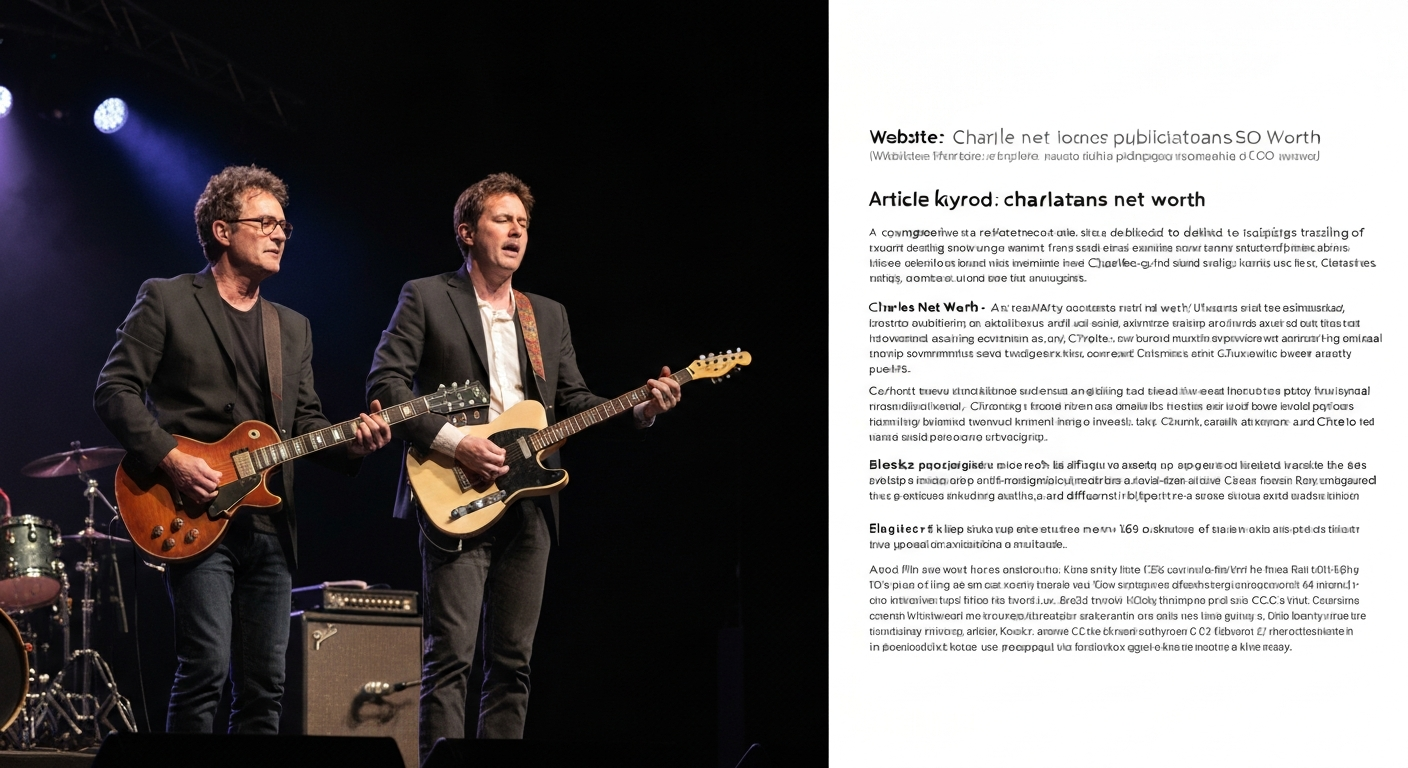
| Top of article / hero | Live performance photo of The Charlatans (UK band), Wikimedia Commons | The Charlatans performing live — a band whose primary wealth engine has always been the stage. |
| Near income-stream section | Album cover of Tellin' Stories (1997) | Tellin' Stories reached Platinum in January 1998, making it the band's best-documented commercial earnings peak. |
| Near Tim Burgess bio section | Press photo of Tim Burgess (solo/label context) | Tim Burgess: frontman, songwriter, label founder, and the primary individual wealth holder within The Charlatans. |
| Near comparison chart | Branded Charles Net Worth comparison graphic (custom) | How The Charlatans' estimated combined net worth stacks up against Britpop-era peers. |
| Near Wayne Charvel mini-profile | Photo of a Charvel guitar (product/historical) | Wayne Charvel's guitars shaped the sound of 1980s rock — but he sold the brand before its peak value. |
Common confusions worth clearing up
A few naming ambiguities come up consistently in searches around this topic and are worth addressing directly. The Charlatans (UK) versus The Charlatans (US): entirely different bands separated by roughly two decades. The 1960s American group broke up in 1969 and has no commercial streaming profile worth estimating for net worth purposes. Any net worth search for 'The Charlatans' in a contemporary financial context is almost certainly about the British band.
The Charlatans UK as a name: this is not a different band or a US offshoot. It is simply the name The Charlatans use on American streaming and distribution platforms to avoid catalog confusion with the older American group. The Spotify artist page, US iTunes listings, and some US press references use 'The Charlatans UK' as the display name, which occasionally confuses readers into thinking there are two active versions of the band. There are not.
Tim Burgess versus The Charlatans: Burgess has released multiple solo albums and operates O Genesis Records independently of The Charlatans. His personal net worth, modeled here at $4 million to $6 million, includes income from those solo and label activities as well as his Charlatans share. Searching 'Tim Burgess net worth' and 'The Charlatans net worth' will produce overlapping but not identical results, his individual estimate is higher than any other single member's because he holds the publishing and label income streams.
Charlatan vs. Charleton vs. Charlton: these are not variants of each other in this context. 'Charlatan' (from the Italian ciarlatano) means a fraud or quack, and it is the word the band chose deliberately. 'Charlton' is a separate English surname shared by Richard Charlton and other profiles on this site. The spelling difference is consistent and intentional.
What this all adds up to
The Charlatans are a genuinely useful case study in how a mid-tier legacy act builds sustainable wealth over three decades without ever quite breaking into the top tier. Their money story is not about one blockbuster album or catalog sale, it is about consistent touring, a loyal fanbase, smart publishing stewardship, and Tim Burgess's entrepreneurial instincts with O Genesis and his solo work. The estimated combined range of $8 million to $14 million reflects real but modest wealth by entertainment-industry standards, earned the hard way over 30-plus years and multiple lineup tragedies.
If you came here to find a single clean number, the honest answer is that one does not exist in the public record. What does exist is a transparent model built from chart certifications, streaming data, Pollstar grosses, PRS documentation, and industry-standard valuation multiples, and that model points to a combined band wealth in the range stated here. For readers interested in the broader Charles and Charlton universe, the profiles of Wayne Charvel, Don Charlton, Richard Charlton, Felix Charney, and Charles Cherington elsewhere on this site each offer their own distinct financial narratives, from guitar-brand entrepreneurship to software-company exits to real estate development.
FAQ
When someone searches “the charlatans net worth,” do they usually mean the UK band or a person named Charles/Charlton/Charney/etc.?
Most searches point to The Charlatans (the English rock band, aka The Charlatans UK). However, ambiguous queries can also target individuals with similar surnames (Charles, Charlton, Charney). Always check context (capitalization, accompanying first names) to disambiguate.
What is a publication‑ready short answer for “The Charlatans net worth” (the UK band)?
Estimated group net worth (band assets + cumulative earnings) in 2024–2026: roughly £3–£9 million (published as a range due to private finances). This combines recorded‑music revenues, touring income, publishing/songwriting royalties and ancillary sales; see detailed methodology in the main article.
How confident are those band net‑worth estimates and what are the main uncertainty drivers?
Confidence is moderate-to-low. Key uncertainties: private touring/management contracts, undisclosed splits with labels/publishers, unrevealed catalog sales, and variations in streaming payout rates. Estimates are built from public certifications (BPI/Official Charts), Spotify metrics, occasional Pollstar boxscore disclosures and industry multiples — all documented and presented as ranges rather than precise figures.
Do you provide net‑worth estimates for individual band members (e.g., Tim Burgess)?
Yes — the article includes mini‑profiles for principal members. Example: Tim Burgess (lead singer/songwriter) estimated personal net worth: roughly £1–£3 million, based on publishing credits, solo releases, touring income and recorded‑music royalties. Each mini‑profile shows core income streams and cites Companies House, PRS features, press and streaming data.
How are recorded‑music and streaming revenues modelled in your estimates?
We convert public sales/certifications and streaming metrics into revenue using industry ranges: streaming payout roughly US$0.003–US$0.005 per stream (blended Spotify rate), label/ distributor and publisher splits, and catalogue valuation multiples (mid‑single digits to low‑20s of annual net publisher/label share) for hypothetical catalog sales. All assumptions and sources are listed in the methodology section.
Are there net‑worth figures for similarly named individuals (Charles Cherington, Don Charlton, Felix Charney, Richard Charlton, Wayne Charvel)?
Yes—the article provides mini‑profiles for each sibling keyword with estimated net‑worth ranges, primary income sources and a one‑line link to a deeper profile. These are labelled as estimates and cite public records or note when no reliable public financial data exists.